
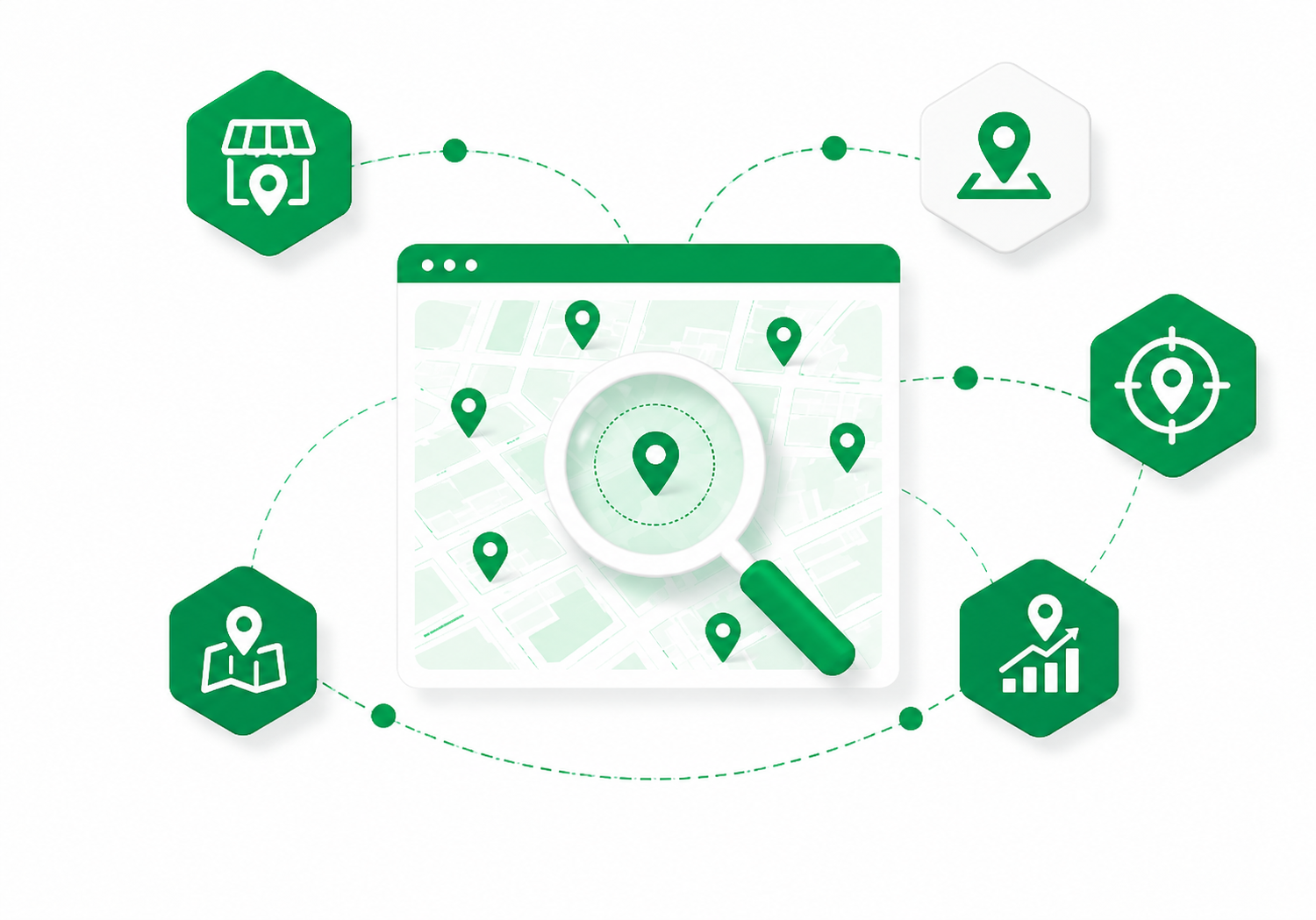
Picture your ideal customer standing two blocks from your door. They pull out their phone, type “[what you do] near me,” and tap one of the first three businesses on the map. If that business isn’t you, you didn’t lose to a better company — you lost to a better-optimized Google Business Profile. And it happens hundreds of times a month, silently, with no notification that it’s even occurring.
“Near me” searches have exploded — Google has reported them growing roughly 500% over a five-year stretch — and about 46% of all Google searches now carry local intent. The stakes are immediate, too: studies show that when someone runs a local search on their phone, the vast majority visit or call a business within a day. Showing up isn’t a vanity metric. It’s same-day revenue. Let’s figure out why you’re not.
How Google Actually Decides the “Near Me” Winners
Google has been openly clear that local rankings rest on three pillars: relevance (how well you match the search), proximity (how close you are to the searcher), and prominence (how well-known and trusted you are). Most of the reasons you’re invisible trace back to one of these three — usually relevance and prominence, because those are the ones you can actually influence.
Proximity is the one you can’t change; you can’t pick up your shop and move it next to every searcher. But here’s the encouraging part the data confirms: a business with strong prominence regularly outranks a closer competitor with a weak profile. You can widen your effective radius by being more relevant and more trusted than the shop down the street.
The Real Reasons You’re Invisible (and the Fixes)
In almost every “why can’t anyone find us” audit we run, the culprit is one or more of these — and the good news is they’re all fixable:
- Your Google Business Profile is incomplete or unclaimed. GBP signals are the single biggest driver of Map Pack rankings — roughly a third of the weight. An unverified, half-filled profile is the most common reason a business simply doesn’t appear. Claim it, verify it, and fill every field.
- Your primary category is wrong or too generic. Your primary category is one of the strongest individual ranking factors there is. “Restaurant” loses to “Mexican Restaurant”; “Contractor” loses to “Bathroom Remodeler.” Pick the most specific category that fits, then add relevant secondary ones.
- You don’t have enough reviews. Reviews now carry serious ranking weight — and businesses with 50+ reviews are dramatically more likely to appear in the local pack than those with fewer than 10. Few reviews is both a ranking problem and a trust problem.
- Your hours or info are inaccurate.“Open at the time of search” became a top-tier ranking signal in 2026. Wrong hours don’t just frustrate customers — they push Google to show an open competitor instead of you.
- Your name, address, and phone number don’t match across the web. Inconsistent NAP across your site, GBP, and directories erodes trust. It rarely wins rankings on its own anymore, but getting it wrong actively hurts you.
- You have no local relevance on your website. No city or neighborhood terms, no location page, no locally relevant content — so Google struggles to connect your site to the area you serve..
Why a “Worse” Competitor Keeps Beating You
This is the question that drives owners crazy: the place across town has uglier branding and a worse product, so how are they in the 3-pack while you’re buried on page two? Almost always, it’s because they quietly nailed the boring fundamentals. They picked the exact right category, they ask every happy customer for a review (so they’ve got 200 to your 15), their hours are perfect, and their profile is complete. Google isn’t judging who’s “better” — it’s judging who sends the clearest, most consistent local signals. The good news: those are signals you can build, starting this week.
Your 30-Day Visibility Fix
Here’s the order we’d tackle it in, highest-impact first:
- Claim, verify, and fully complete your Google Business Profile. Every field, the right primary category, accurate hours, services, and attributes.
- Launch a simple review engine. Ask every satisfied customer, make it one tap (a short link or QR code), and respond to every review you get. Aim to steadily climb past that 50-review threshold.
- Add fresh photos and GBP posts weekly. Geotagged photos and regular posts feed the engagement signals Google rewards.
- Fix your NAP everywhere and get listed consistently in the major local directories.
- Build local relevance on your site — a real location or service-area page with city and neighborhood terms, plus locally useful content.
Two Situations That Need Extra Care
A couple of common setups trip businesses up, so they’re worth calling out:
You serve customers at their location (no storefront). Service-area businesses — plumbers, cleaners, mobile groomers, contractors — sometimes hide their address and wonder why they can’t rank. Google’s local algorithm leans on a real address in the city being searched, so set up your service area correctly and make sure your map pin is accurate rather than hidden. If you serve several towns, a dedicated, genuinely useful page for each one gives Google something concrete to rank for each market — a single “areas we serve” page listing five cities usually isn’t enough.
You’re chasing a wider radius than your prominence supports. Proximity is brutal: a closer competitor with a complete profile often wins, and you can’t move your address. The only lever is to out-build them on prominence — more recent reviews, consistent citations, local backlinks, and real authority — which steadily widens the radius where you can outrank nearer-but-weaker businesses. There’s no shortcut here, which is exactly why it’s defensible once you do it.
And keep one eye on where this is heading: a large and rising share of local searches now trigger an AI summary, and more people are asking ChatGPT and Perplexity for “near me” recommendations directly. The same fundamentals — a complete profile, steady reviews, consistent information — are what feed those AI answers too, so the work compounds across both Google and AI.
Stop losing same-day customers to the business down the street.
Every “near me” search you miss is a customer who walked into someone else’s store today. GrowthVance will audit your local presence for free — your Google Business Profile, categories, reviews, and the exact reasons you’re not in the Map Pack — and show you the fastest path to the top three.