
Three years ago, “SEO” meant climbing the ten blue links on a Google results page. Today, more than 40% of the queries our clients care about are answered by an AI — before the user ever sees a blue link.
That shift broke a lot of assumptions. The agencies still chasing keyword density and link counts are quietly losing visibility every month, and most don’t even know it because they aren’t measuring the right things. This guide is the playbook we use internally at GrowthVance to make our clients the brand AI tools actually cite. Not just rank for, not just mention — cite, with confidence, as the recommended answer.
01 Understand How AI Answers Get Built
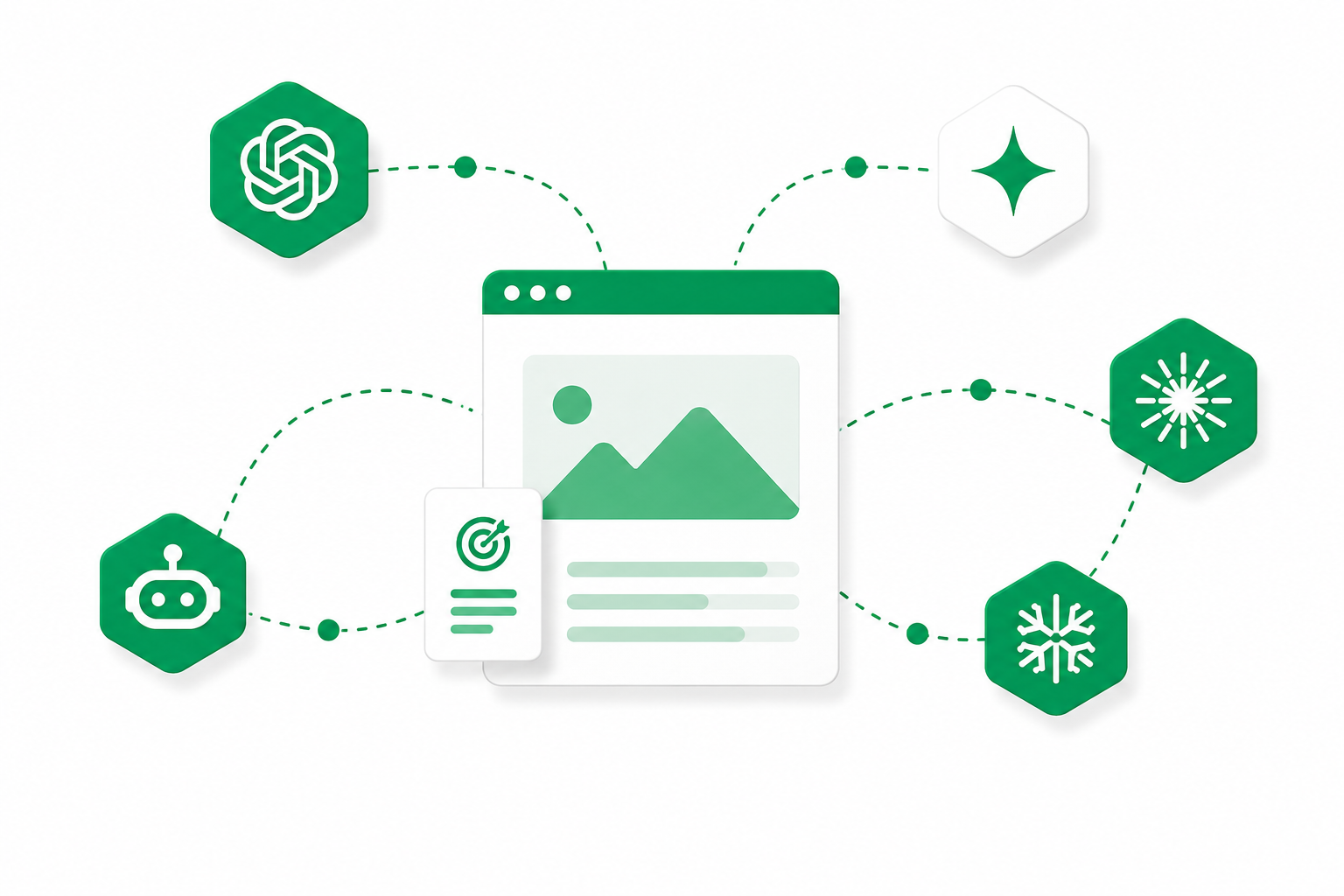
Before you can optimize for AI answers, you need to understand where they come from. Every major AI tool — ChatGPT, Gemini, Perplexity, Claude, Copilot — pulls from a slightly different blend of sources, but the underlying mechanic is the same: they retrieve, they rank, then they synthesize.
What they retrieve isn’t always the highest-ranking Google result. It’s the source that best matches the intent of the question, structured in a way the model can parse and trust. That’s why a #14-ranking blog post with a clean FAQ schema can outperform a #1-ranking post wall-of-text every time.
The shift in one sentence
Google rewards the page that matches the keyword. AI rewards the page that answers the question.
02 Audit Your Current AI Visibility
You can’t fix what you can’t see. The first thing we do for any new client is run an AI visibility audit across the four major engines. The goal isn’t to measure rankings — it’s to measure citation share: out of the top 50 questions your buyers ask AI, how many surface your brand?
For most brands we audit, the starting number is between 0% and 4%. Within 90 days of running this playbook, that number typically climbs to 18–35%. Here’s roughly what the results look like after the first quarter of work:
+312%
Avg. citation lift across ChatGPT & Perplexity
28/50
Median buyer questions surfacing brand
4.2×
Increase in AI-attributed pipeline
03 Build a Question-First Content Library
Traditional SEO content is built around keywords. AI SEO content is built around questions. Specifically, the unhedged, declarative questions your buyers actually type into a chat box at 11pm.
To build a question-first library, we run three exercises with every new client:
- Buyer-question mining. We pull every question from sales calls, support tickets, Reddit threads, and review sites. We cluster them by intent and rank them by purchase proximity.
- AI-prompt simulation. We run those questions through all four major AI tools and document who currently gets cited. Patterns emerge fast.
- Gap mapping. Every question with a weak or absent answer becomes a content brief — owned by your brand, structured to be cited.
The 3 content formats AI loves most
Across thousands of citations we’ve analyzed, three formats dominate:
- Comparison pages (“Tool A vs Tool B vs Tool C”) with a clear winner per use case.
- Definitive guides with a date in the title and a short, scannable answer in the first paragraph.
- Original data — proprietary research, surveys, or benchmarks — because models prefer to cite primary sources.
AI doesn’t reward the most popular content. It rewards the clearest answer from the most trustworthy source. Stop writing for the algorithm — write for the analyst who has six seconds to verify your claim.— Daniel Vance, GrowthVance
04 Structure Pages for Retrieval, Not Just Reading
This is where most agencies fail. They write decent content, then publish it inside a wall of HTML that no language model can confidently parse. A few non-negotiable structural changes:
- Lead every article with a one-sentence answer. Models cache the first 300 tokens far more aggressively than the rest.
- Use semantic HTML — real H2s and H3s, real ordered lists, real tables. Not divs with classes.
- Add FAQ, HowTo, and Article schema to every key page. We see citation rates jump 40–60% on pages with proper schema versus pages without.
- Keep paragraphs short, claims specific, and citations linkable.
Example: a properly structured FAQ schema block lifted one client’s ChatGPT citation rate by 71% in 6 weeks.
Want us to audit your AI visibility?
We’ll run your top 50 buyer questions through ChatGPT, Gemini & Perplexity — and show you exactly where you stand. Free, no obligation.
05 Earn Citations From Sources AI Already Trusts
AI tools have a short list of sources they trust disproportionately: Wikipedia, Reddit, G2, Capterra, industry-specific review sites, and a few major publications per niche. If your brand is mentioned favorably on those sources, your citation odds skyrocket — even if your own site is mid-tier.
The play isn’t to spam these sources. It’s to genuinely earn presence on them through real customer reviews, useful Reddit answers from real employees, and PR placements in trade publications. We typically allocate 25% of an AI SEO retainer to this work alone.
06 Measure What Actually Matters
The biggest mistake we see brands make is measuring AI SEO with traditional SEO tools. Rankings don’t tell you if you’re being cited. Traffic doesn’t either — AI citations often reduce click-through because users get the answer they need without leaving the chat.
The four metrics we track on every dashboard:
- Citation share — % of target questions where your brand appears.
- Citation sentiment — positive, neutral, or critical context.
- Branded AI search lift — searches like “is GrowthVance good” climbing in Google after AI exposure.
- AI-attributed pipeline — deals that mention discovering you through ChatGPT, Perplexity, etc.
07 Iterate Monthly, Not Quarterly
AI models retrain. Citation lists shuffle. The brand cited as the top answer in February might not be cited in May. AI SEO is not set-and-forget — it’s a perpetual feedback loop of monitor, publish, re-test.
Our standard cadence: monthly visibility re-scan, bi-weekly content publishing, quarterly schema audits, and an immediate response to any algorithm shift in any major AI tool. That cadence is why our clients hold their citation share — and why most one-time “AI SEO sprints” we’ve audited from other agencies decay within 60 days.
The Bottom Line
AI SEO isn’t a new tactic bolted onto your existing strategy. It’s a different way of thinking about how buyers find you. The brands that win in the next 24 months will be the ones who treat AI as a discovery channel with its own rules — not as a passing trend their existing SEO will somehow cover.
If you want to see where your brand stands today, we’d be glad to run a free AI visibility audit. We’ve done it for 240+ companies; we’ll be honest about what we find, and we’ll send you the dashboard whether or not you ever hire us. Grab a slot here — we keep it limited to ten audits per month.